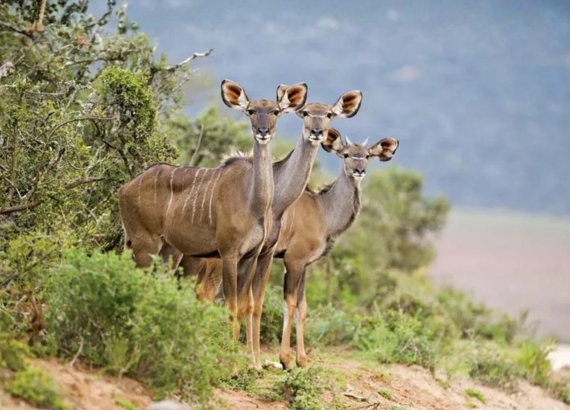
With their majestic spiral horns, elegant stature, and distinctive white stripes, the Greater Kudu is widely considered one of the handsomest antelopes in the African bushveld. But as striking as they are to look at, they come with a linguistic twist that catches even seasoned safari-goers off guard!
In the latest episode of The Ranger Diaries, Ranger Ruben takes a pause to highlight these iconic creatures—and unpack the tricky, tongue-twisting collective nouns that describe them.
Trop or Forkle? Understanding Bushveld Terminology
If you’re traveling through South Africa, you’ll often hear local guides refer to a group of kudu using the Afrikaans word, trop (meaning herd). It rolls easily off the tongue and is commonly heard across the bushveld.
However, if you dive into traditional English collective nouns, a group of these magnificent antelopes is officially known as a forkle of kudu!
Try saying “a forkle of kudu” three times fast while bouncing along on an open safari vehicle—it’s an absolute tongue-twister! Whether you call them a herd, a trop, or a forkle, spotting a group of them moving gracefully through the acacia trees is always a highlight of any drive.
The “Grey Ghosts” of the Waterberg
Beyond their quirky collective noun, kudu are fascinating animals to observe in the wild. Often referred to by rangers as the “Grey Ghosts of the Bush,” their subtle grey-brown coats and vertical white stripes provide masterclass camouflage against the dappled light of the Waterberg thickets.
One moment you’re staring at what appears to be a thick patch of dry brush, and the next, a massive bull steps into the sunlight, displaying a spectacular set of twisting horns that can reach up to six feet in length. Despite their large size—bulls can weigh over 250 kilograms—they are surprisingly agile jumpers, easily clearing fences and obstacles over two meters high!
Uncover the Magic of the Bush with Our Rangers
It’s small, fun insights like these that make a guided drive at Mabalingwe Nature Reserve so special. Rangers like Ruben don’t just point out animals; they bring the bushveld to life with rich stories, local terminology, and deep ecological knowledge that turns every drive into an adventure.
Next time you join us on an open-vehicle safari across our 8,500 hectares, keep your eyes peeled for those tall, radar-like ears twitching in the brush. You might just spot a full forkle of kudu gracefully browsing on the acacia leaves!
Have you been lucky enough to spot a forkle of kudu on your recent drives through Mabalingwe?