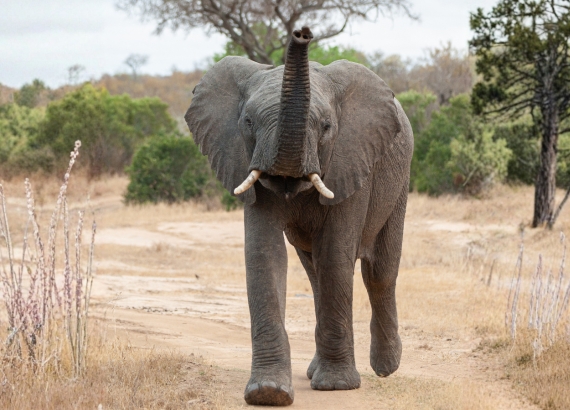
If you have ever stood in awe near a herd of gentle giants during a game drive at Mabalingwe Nature Reserve, your eyes were likely drawn to their most defining feature: the trunk. Far more than just an oversized nose, an elephant’s trunk is a marvelous evolutionary masterpiece.
In the latest episode of The Ranger Diaries, Field Guide Lazarus breaks down why this extraordinary organ is truly an elephant’s ultimate lifeline.
A Marvel of Biological Engineering
To truly appreciate what an elephant can do with its trunk, you have to look beneath the surface. An elephant’s trunk contains no bones and very little fat—instead, it is composed of approximately 40,000 individual muscles. For comparison, the entire human body has just over 600 muscles! This incredible concentration of muscular power gives the trunk a unique combination of strength and delicacy. An elephant can use it to knock over massive trees or pick up a single blade of grass with equal ease.
As Lazarus points out, the trunk is fundamental to every aspect of an elephant’s daily survival:
- Feeding & Foraging: It acts as a versatile arm to reach high branches, strip nutritious bark, or pluck soft vegetation from the ground.
- Breathing & Snorkeling: Serving as the main airway, the trunk allows elephants to smell predators from miles away and acts as a built-in snorkel when swimming across deep rivers.
- Drinking in Volumes: While elephants do not drink through their trunks like a straw, they use them to draw up 8 to 10 liters of water at a time before spraying it directly into their mouths.
Nature’s Built-In Climate Control
Living on the warm South African savanna means finding clever ways to regulate body temperature. Without traditional sweat glands, elephants rely heavily on their trunks for cooling. By drawing up water, mud, or loose sand, they spray their backs and flanks. This creates a protective, cooling layer that acts as both a natural sunblock and a defense against biting insects.
Next time you watch an elephant quietly moving through the bush, take a moment to observe how constantly its trunk is in motion. It is sensing, cooling, feeding, and breathing—a true wonder of the natural world.